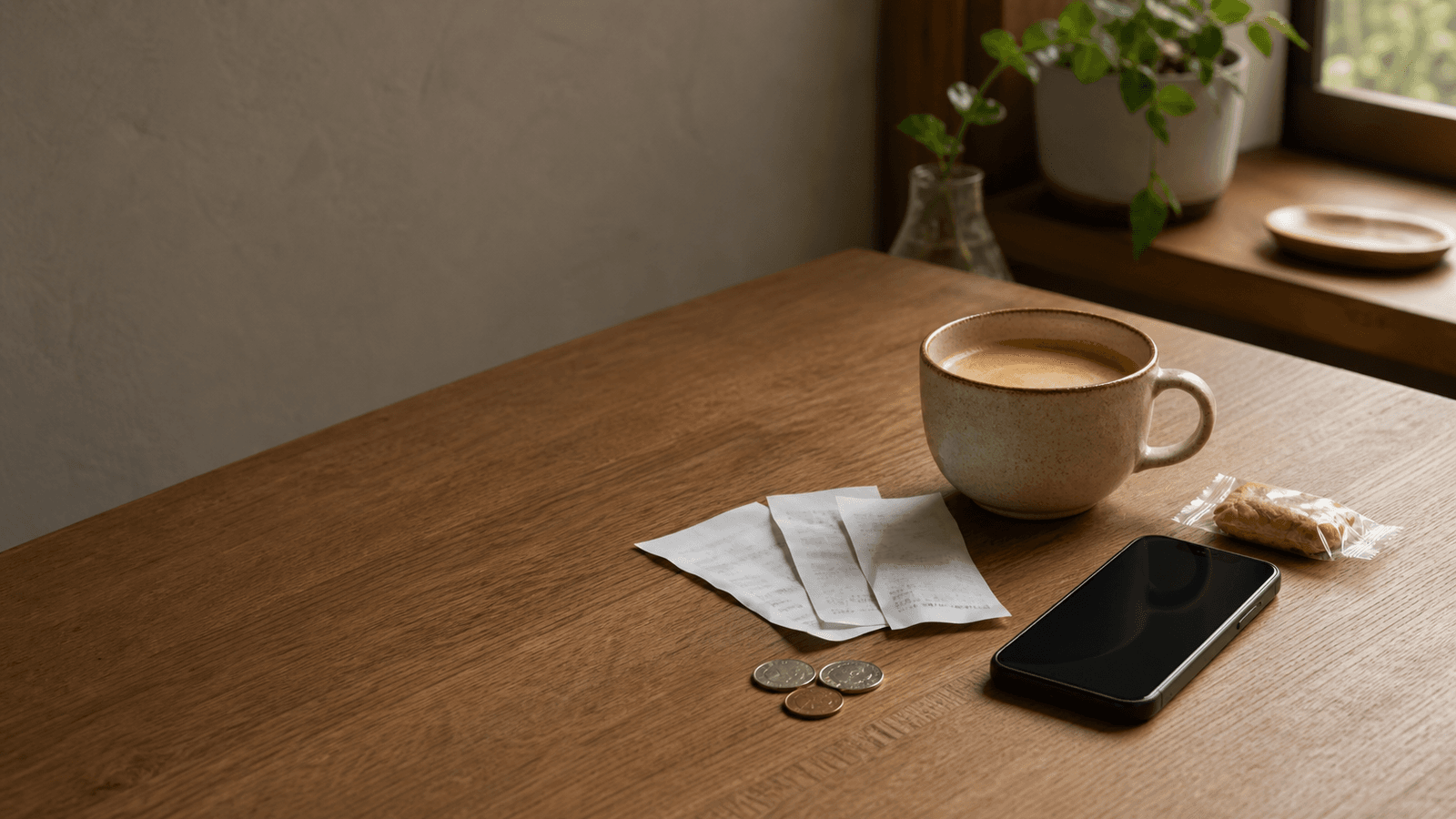
The snack you pick up at a convenience store, coffee before work, a subscription you have stopped using: each one can seem too small to matter. Together, they can affect what is left at the end of the month.
These everyday small expenses are often called latte money. The point is not to remove every small pleasure. It is to separate spending that genuinely supports you from spending that continues on autopilot.
What is latte money?
Latte money is the accumulation of small, easy-to-overlook expenses—such as coffee, snacks, or minor fees. The phrase is associated with The Latte Factor, a personal-finance idea popularized by author David Bach.*¹
It is not limited to coffee. ATM fees, shopping bags, unused subscriptions, and small in-app purchases can also fit the pattern.
The average was ¥13,572 a month?
In a 2025 web survey of 218 users of the Japanese budgeting app OneBank, respondents estimated their latte-money spending at an average of ¥13,572 per month, or ¥162,864 over a year.*²
This is a self-reported figure from OneBank users, not an average for everyone. Still, it is a useful prompt: spending that feels minor on a single day can become meaningful over a month.
For example, spending ¥300 on 20 weekdays totals ¥6,000 a month. At ¥500, it becomes ¥10,000. Rather than cutting it all, decide what you want to keep.
You do not have to eliminate every small expense
A coffee you look forward to or a small reward between work and home responsibilities can be a worthwhile expense. Purchases you do not remember, or services you barely use, are stronger candidates for review.
Instead of judging by category alone, ask: Would I willingly pay for this again in the same situation?
| Expense | Example | Question to ask |
|---|---|---|
| ☕ Coffee | Cafés and convenience stores | Is it a pleasure or just routine? |
| 🍪 Snacks | An extra stop at a convenience store | Did I plan to buy it? |
| 🏧 ATM fees | Out-of-hours cash withdrawals | Is there a free time or method? |
| 🛍️ Shopping bags | Small purchases every time | Could I bring a bag? |
| 📱 Subscriptions | Video, music, or apps | Have I used it lately? |
| 🎮 Microtransactions | Games and in-app purchases | Do I know the monthly total? |

Good latte money vs. bad latte money
The same ¥400 coffee can be good latte money when you choose it deliberately and it gives you a useful break. It may be bad latte money when you buy it by habit, do not finish it, and regret it afterward.
| Look at | 😊 Worth keeping | 😶 Worth rethinking |
|---|---|---|
| Before buying | You choose it deliberately | You buy from habit |
| After buying | You feel satisfied or refreshed | You forget it or regret it |
| Frequency | It fits within a limit | You do not know the total |
| Next time | You would pay again | You would not miss it |
| What to do | Keep it and plan for it | Reduce, stop, or replace it |
How to manage latte money
Review it in three steps
Estimated time: 3 steps
- Make small expenses visibleCheck your statements or purchase history for coffee, convenience-store visits, fees, and subscriptions. Look at the monthly total.
- Sort: keep, rethink, or pauseKeep what you would willingly pay for again. Rethink what you can live without. If you are unsure, pause rather than cutting it immediately.
- Set an amount you are happy to useSet a limit for small pleasures from your monthly discretionary money. Use the method you can sustain—a budget notebook, statements, or a simple note—and check the amount used regularly.
Your budget does not need to be the same every day. You might spend more on something you enjoy today and spend less another day. What matters is being able to return to your monthly limit.
Summary
Latte money is the accumulation of small expenses that are easy to overlook.
- Keep spending that brings satisfaction or energy, with a limit.
- Review spending driven by habit, low use, or regret.
- Choose a spending limit and a regular time to check it.
Start with your latest statement. Find one small expense you would gladly pay for again, and one you would not miss.
References
- ¹ David Bach, The Latte Factor — Why I Wrote This Book Now (May 6, 2019; checked July 28, 2026).
- ² SmartBank, Survey on latte money (September 18, 2025). Self-reported web survey of 218 OneBank users in Japan.
- ³ Japan FP Association, What is “latte money”? (updated May 13, 2026; checked July 28, 2026).
Editorial details
- Price checked
- Jul 28, 2026
- Fact checked
- Jul 28, 2026
- Theme ID
- AQM-034